


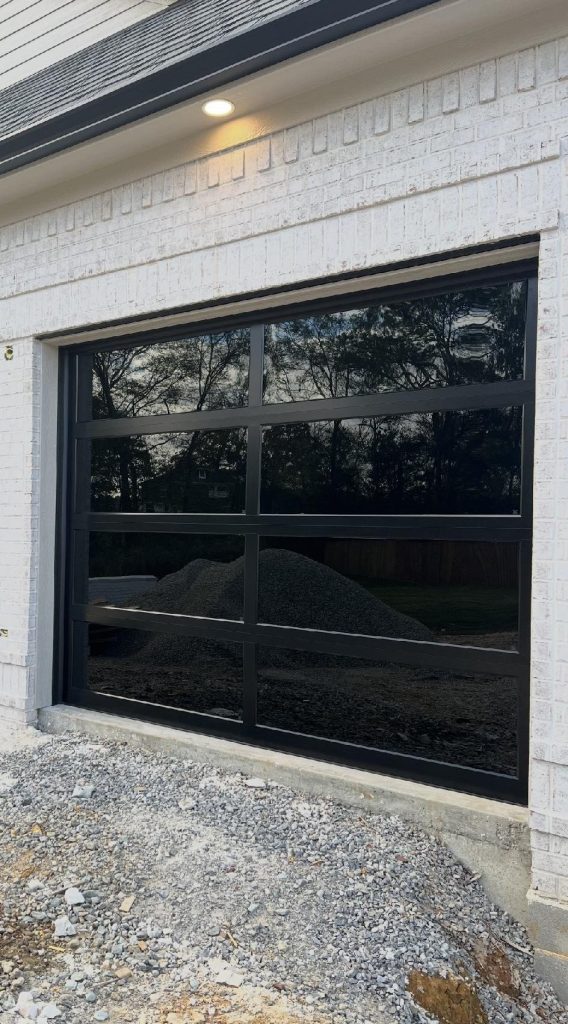
The car is inside, the garage door will not open, and you need to leave. Keep the engine off. Before reaching for the red release handle, look at the door from outside its path: a broken spring, slack cable, tilted bottom edge, or door stuck partway up makes this a safety problem, not a button problem.
State Line Garage Doors serves Lawrenceburg, Tennessee, and nearby communities with garage door repair and emergency service. This guide helps you decide what to leave alone, what you can check without moving the door, and what to tell the person answering your call. It does not ask you to diagnose a spring or lift a door of unknown condition.
First, Protect People Rather Than the Vehicle
If the door is crooked, unusually heavy, off its track, partly suspended, or shows a broken spring, damaged cable, loose drum, or unstable bracket, do not use the garage door until a technician has inspected it. Do not press the opener again, pull the emergency release, push a corner, or stand beneath it. Keep children and pets out of the opening.
The Door & Access Systems Manufacturers Association (DASMA) safety guidance warns that springs and related cables and bottom brackets can be dangerous under tension; its residential inspection sheet explicitly says not to operate a door with a broken spring.
If someone is injured, physically trapped, or exposed to fire or another immediate threat, leave by another safe exit if possible and call emergency services. A stranded car alone is not the same as a person in danger. If the vehicle is needed soon, arrange another ride while repair is scheduled rather than trading an access delay for an injury.
Do not idle the car inside the garage. The Centers for Disease Control and Prevention’s carbon monoxide guidance says never to run a car in an attached garage, even with the door open. If an engine has been running and someone has a headache, dizziness, nausea, or confusion, get to fresh air and seek emergency medical help. Do not wait for the overhead door to be repaired before protecting people.
A One-Minute Triage You Can Do Without Moving the Door
Stand where you can see the door without being beneath it. Look and listen only to what has already happened; this is not permission to run a test cycle. A fully closed, level door with no visible damage is a different situation from one that hangs halfway open.
| What You Already Know | What It Could Mean | Safest Next Move |
| One corner is higher, a roller is out, or a cable is slack | The door may be unstable or out of balance | Keep clear; request repair. Do not use the door until inspected. |
| You heard a bang, then the door rose only slightly | A spring or lift-system fault is possible | Stop all operation; report the sound and travel. |
| The opener hums or moves but the door stays shut | The opener or the door system may have failed | Stop retries; request a door-and-opener inspection. |
| Nothing responds and other garage lights are out | A household power problem may be involved | Check power only from a safe location; do not touch wiring. |
| Only one remote failed and the door is closed, level, and otherwise normal | The remote or a control setting may be involved | Check the remote’s accessible battery and exact-model manual. |
| The door is stuck partway open | It may be unstable and the property may be unsecured | Stay out of its path and report the position when calling. |
These are possibilities, not diagnoses. Report the door’s position, whether it stayed level, and whether the opener made a sound.
What to Check When the Door Is Fully Closed and Looks Sound
Keep these checks noninvasive. If the door has jerked, strained, tilted, or made a new sharp sound, skip them and call. A visual look cannot certify a spring or cable safe; uncertainty is a reason to stop.
Is This a Whole-House Power Problem?
Notice whether nearby lights or other normal household devices work. If the garage has lost power, check the utility outage from a safe place. Inspect a familiar household breaker only if it is dry, undamaged, and accessible without a ladder or exposure to wiring.
Do not open the motor housing, work on the opener’s logic board, probe an outlet, or reset a breaker that trips again. Smoke, heat, water, or a burning smell calls for qualified electrical help and, when there is immediate danger, emergency services. A power outage does not show that the door is balanced or safe to lift.
Battery backup depends on the model and battery condition. DASMA’s power-outage technical sheet recommends periodic testing. Do not use a backup to move a damaged door.
Is It Only the Handheld Remote?
If only one remote failed, its accessible battery or a lock feature could be involved. Check the exact-model manual without moving the door. Indicator lights vary by model.
If a second control produced scraping, uneven travel, or a strained motor sound, stop. Do not keep pressing different controls. State Line’s opener service information describes its work, but DASMA says a stronger opener does not cure an out-of-balance door.
Are You Confusing a Closing Problem With an Opening Problem?
Photo eyes protect the closing path. If a door started to close and reversed, a loose object blocking the beam may be relevant. If your car is trapped behind a door that will not rise, dirty photo eyes are not the automatic diagnosis. DASMA’s opener safety page describes reversal on closing.
Do not cover the sensors, hold a wall button to override protection, or raise opener force to get one more trip. If the door itself is straight and undamaged and you can see a loose object from outside the path, you can report it or move it only when doing so requires no reach beneath a door. Otherwise, leave it for the technician.
Why the Red Release Handle Is Not the First Fix
The emergency-release handle disconnects an opener from its door; it does not repair a broken spring, cable, jammed track, or damaged section. A released door may suddenly move if its counterbalance is compromised. Never pull it on a crooked, raised, partly raised, unusually heavy, or visibly damaged door. Do not use it to find out whether the spring is broken.
DASMA’s residential inspection sheet discusses a manual-release handle with the door fully closed, in a routine inspection context. That is not permission to disconnect a suspect door. If you cannot verify your model and door condition, wait for help.
If the release was already pulled, tell the technician. Do not reconnect or run the motor against an unknown door. Do not recruit others, use a vehicle, tie a rope to it, or jack it up.
When the Motor Runs and the Door Does Not
A running motor proves only that it received a command. It cannot distinguish a drive fault, disconnection, broken spring, or binding door. Stop after observing the failure.
From a safe position, note whether the door shifted at all and whether both sides moved evenly. A loud bang before the failure, a visible gap in a spring, or a slack cable is a hard stop. State Line offers spring replacement and cable repair, but the appropriate work follows inspection. Don’t touch the cable, drum, bottom bracket, spring, or fasteners.
An old opener is not necessarily the fault. If the door is sound and only a control failed, replacing the whole opener might be unnecessary. Ask what the evidence shows.
What to Do With a Door Stuck Partway Open
Treat a suspended or crooked door as unstable. Don’t walk, drive, or crawl underneath it; don’t try to pull it down to secure the house. Keep the opener controls away from other household members so nobody accidentally cycles it while you wait.
If you can secure another entrance without approaching the opening, do that. Tell the repair dispatcher if the opening cannot be secured and whether a vehicle is beneath or beside the door. If someone has no other safe way out of the building or faces immediate danger, contact emergency services instead of relying on a routine repair response.
In Lawrenceburg, Pulaski, Loretto, or Florence, Alabama, give your actual service address and safe access route. Confirm the current dispatch window when you call; same-day service is not a guaranteed arrival time.
What to Tell State Line When You Call
You need not decide whether the spring or motor failed. Justin, State Line’s Lawrenceburg-born owner, described his approach as explaining “what needs to change” and why. Give the team observations so the visit starts with the right safety question.
Have this short report ready if you can collect it without moving the door:
- People first: Is anyone trapped or hurt? Is the vehicle simply unavailable, and do you have another safe exit?
- Door position: Fully closed, partway open, or fully open? Is the bottom edge level?
- Warning signs: A bang, gap in a spring, frayed or slack cable, displaced roller, impact, burning smell, or new grinding?
- Control history: Which control was used last, did the motor respond, and did either side move?
- Access and timing: Your address, a safe way to reach the garage, when you need the car, and whether another ride is possible.
A photo from a safe position can help; never enter the opening for a better angle. Mention the opener model if you already know it.
Call State Line Garage Doors at (931) 771-6788 to ask about emergency availability, the visit charge, and the next safe step. The contact page is useful for non-urgent messages, but a form submission is not a substitute for confirming an urgent dispatch by phone.
What Will an Emergency Repair Cost?
There is no honest single price for a car trapped inside a garage. An accessible remote battery, a failed opener component, a broken spring, and a damaged door are different jobs. Door size, the condition of related hardware, parts, labor, travel, and after-hours timing can all change the total.
Before booking, ask about the diagnostic or trip charge and any after-hours fee. After inspection, request a written, itemized scope showing the necessary repair, parts, labor, and any optional alternative. Ask what can wait, what must be corrected before using the door, and whether a focused repair avoids a replacement. State Line’s owner talks about quality service at a fair price and explaining the change, not selling a motor merely because the opener made noise.
No client-approved dollar range for this exact emergency was available for this draft. A national generic estimate would not be a State Line quote for Lawrenceburg or an after-hours visit. The number to use is the current charge the team confirms and the estimate for your actual door. If timing matters more than retrieving the car today, compare the service timing with the cost and safety of arranging another ride.
Frequently Asked Questions
Can I Pull the Emergency Release if My Car Is Trapped?
Not on a crooked, heavy, raised, or suspect door, and never if a spring or cable may be damaged. Do not use the garage door until a technician has inspected it. For an apparently sound, fully closed door, the exact opener manual governs routine release use, but a car delay is not a reason to guess at the door’s balance.
Can I Open the Door by Hand With a Broken Spring?
Do not try. DASMA’s inspection guidance says not to operate a door with a broken spring. Arrange another ride and request professional inspection; a broken spring is not a safe do-it-yourself repair.
Does a Humming Opener Mean the Motor Is Bad?
No. The sound does not separate a drive fault from a door that is stuck or heavy. Stop retries and tell the technician what moved and what did not. A stronger motor will not fix a door that is out of balance.
Could a Power Outage Be the Whole Problem?
It could explain why an opener without working backup does not respond. Check ordinary household power from a safe location. Do not assume the door is safe to lift, touch wet electrical parts, or open the logic-board housing. If power returns and the door still strains, arrange inspection.
Are the Photo Eyes Keeping My Car Inside?
Not necessarily. Photo eyes normally protect a closing door from an obstructed path; they are not the first explanation for a fully closed door that will not open. Do not bypass them or force movement. Report any unusual sensor lights and consult the exact model manual.
Is This a 911 Emergency or a Garage Door Service Call?
A car you cannot retrieve is usually a service and transportation problem. A person who is injured, physically trapped, facing fire, or exposed to exhaust is a human emergency. Leave by a safe route and call emergency services when people are in immediate danger; do not wait for garage-door dispatch.
How Much Is Emergency Garage Door Repair Near Lawrenceburg?
Ask for the current visit and after-hours charges when you call. The total depends on the diagnosed failure, door and opener, parts, labor, and timing. Request an itemized estimate before authorizing work; a remote battery and a spring replacement cannot share one meaningful price.
Can State Line Come Out Tonight?
State Line lists 24/7 hours and emergency or same-day service, and its public contact page advertises emergency service. Call (931) 771-6788 to confirm actual availability for your address and door condition. Do not assume a particular arrival time or drive an unsafe door while waiting.
Get the Car Back Without Gambling on the Door
Leave the engine off, keep people away from a suspect door, and choose another ride if you need to leave before repair. Then tell State Line Garage Doors whether the door is closed or suspended, what the opener did, and which warning signs you saw. A clear diagnosis should explain what needs to change and what does not.
For emergency garage door repair in Lawrenceburg and the surrounding State Line service area, call (931) 771-6788. Ask about current availability and visit charges before authorizing work. The goal is safe access and an understandable repair, not one more risky button press.